'The Himmatsinghji Report is still 'missing'.' 'It is a great loss for the knowledge of India's borders.' 'It would have an immense value at a time China is bound to shift its attention to other border fronts in the Himalayas,' notes Claude Arpi.

-- Seven suicide bombers believed to be members of an Islamist extremist group carried out the series of explosions. -- Police have so far arrested 24 people - mostly members of an Islamist extremist group - in connection with the blasts

'General J S Aurora, the commander of the Indian forces in the East, asked General Sagat Singh to withdraw his troops who were on the move to Dacca -- but he refused.' 'He said, "Jaggi, over my dead body".' 'Therefore, I say the creator of Bangladesh was General Sagat Singh.'

When China protested strongly over the August decision on J&K -- not once but twice -- we ignored it. And to compound matters, we simply turned our back and walked over to the 'Quad' alliance with the US, upgrading it to ministerial level, and thereafter began following the American footfalls on Taiwan and COVID-19 to taunt and humiliate Beijing, observes Ambassador M K Bhadrakumar.

Here's a glimpse of all that happened around the world last week, in 16 images.

The onus today is on China, but it also requires a little diplomatic finesse from India, backed by a modernised armed force, argues BJP MP Subramanian Swamy in this excerpt from his new book, Himalayan Challenge: India, China And The Quest For Peace.
'The one thing India has over these two States, whose toughness awes us, is our ability to embrace diversity with ease. 'The way ahead lies in learning from Vajpayee's method, not in Xi Jinping's,' says Shekhar Gupta.
Tarun Vijay, MP, salutes the General whom he adored as a great friend.

Some of the best photographs, clicked across the globe in January.

'Absolute non-violence is not only sinful, but immoral.' 'This doctrine of non-violence benumbed the revolutionary fervor, softened the limbs and hearts of the Hindus, and stiffened the bones of enemies.' A revealing excerpt from Vikram Sampath's Savarkar (Part 2): A Contested Legacy, 1924-1966.
'No amount of economic measures or prosperity in Kashmir will make any dent in the situation there. The average Kashmiri understands the Pakistani game and is unlikely to prefer Pakistan over India. But the Pakistanis have made clever use of religious symbols and slogans to force religious-minded Kashmiris to support them. India has failed to counter this posturing by the separatists,' says Colonel Anil A Athale (retd).
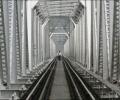
India has planned 14 strategic railway lines in areas bordering China, Pakistan and Nepal, but most of these projects are stuck for want of funds. Anusha Soni reports

'We should not flatter ourselves that China is fixated on encircling India. She has greater goals, becoming the pre-eminent power in the world, and India as a major power is dealt with as part of that strategy.'

Israel is no longer the valiant and beleaguered underdog, but increasingly seen as an increasingly arrogant oppressor seeking to crush another old nation under its jackboots, says Mohan Guruswamy.

Indian agencies have been engaged in countering Pakistani cyber-attacks on social media platforms for a very long time. But just like the fight against the coronavirus, only through the active participation of ordinary citizens that this war on fake news can be won, suggets Colonel S Dinny (retd).

We present our alphabet of 2020, pulling in everything you'll remember about this year we'd rather forget.
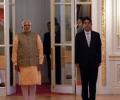
Narendra Modi and his government should look at the emerging geo-politics realistically and not get sucked into having to make a choice between China and Japan. India has enough economic space for both, says Mohan Guruswamy.
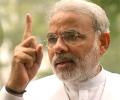
To be sure, Modi is no Vajpayee; at least that is the impression he gives. However, this doesn't mean that he will be looking for a fight. All it means is that if Pakistan seeks a fight, he will not back down. What it also means is that the pusillanimous approach of the previous governments to ceaseless provocations from Pakistan will probably change, says Sushant Sareen.

'Vietnam has become an adjective as well as a verb -- the Americans, for instance, were driven by the passion to do a 'Vietnam' on the Soviet Union when that country invaded Afghanistan in 1979.'

The International Fleet Review, conceived as a show of the country's naval might and readiness for battle, saw as many as 100 naval ships, including 70 from the Indian Navy, taking part in the second edition of the coveted event.

Full transcript of President Obama's speech at the Siri Fort Auditorium in New Delhi.

Very few today realise that without Brigadier John Dalvi's courage, we would never have known what really happened during those tragic days of October/November 1962, reveals Claude Arpi.

'How can Kashmir be demilitarised if the terrorist threat remains and Pakistan continues to incite elements in Kashmir to keep the internal situation unstable?' asks former foreign secretary Kanwal Sibal.

'If Indian armed forces entered Pakistan and succeeded in inflicting major damage on the Pakistani army and occupied territory in the Pakistani heartland, there is reason to think the Pakistani military would use some nuclear weapons against the incoming Indian forces to compel India to stop.'

'India was in no position to wage another war in 1965, having suffered a morale-shattering defeat in 1962. The three services were in the middle of a modernisation and expansion phase and therefore not fully trained or battle-ready.'
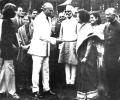
'Indira Gandhi, it appears, did not to consult her Cabinet colleagues, or diplomats, or civil servants when she decided to sign the agreement in Shimla.' 'We ruefully recall Bhutto's perfidy and the Indian prime minister's gullibility,' says Lieutenant General Ashok Joshi (retd).

Nearly two decades ago, then defence minister George Fernandes said: 'China has built roads up to the border, while there has been negligence on India's part.' Since Fernandes uttered these brave words, what has been done on the Indian side? The Modi Sarkar is apparently trying, but little has been achieved so far, says Claude Arpi.

Lieutenant General J F R Jacob, Chief of Staff, Eastern Army Command during the 1971 war, revealed how, armed with only a draft surrender document and an aide, he made the Pakistani army led by Lieutenant General A A K Niazi surrender.
Lieutenant General J F R Jacob, Chief of Staff, Eastern Army Command during the 1971 war, revealed how, armed with only a draft surrender document and an aide, he made the Pakistani army led by Lieutenant General A A K Niazi surrender.
Lieutenant General J F R Jacob, Chief of Staff, Eastern Army Command during the 1971 war, revealed how, armed with only a draft surrender document and an aide, he made the Pakistani army led by Lieutenant General A A K Niazi surrender.
Lieutenant General J F R Jacob, Chief of Staff, Eastern Army Command during the 1971 war, revealed how, armed with only a draft surrender document and an aide, he made the Pakistani army led by Lieutenant General A A K Niazi surrender.
Lieutenant General J F R Jacob, Chief of Staff, Eastern Army Command during the 1971 war, reveals how, armed with only a draft surrender document and an aide, he made the Pakistani army led by Lieutenant General A A K Niazi surrender.

'This is a movie made with this gaze fixed on its immediate well-wishers, while at the same time it squints hard looking for those swaying back and forth on the fence,' notes Rohit Sathish Nair.

Instead, increases in foreign-direct-investment levels; and reforms to make labour, land and capital more mobile.
While we have to hiss loudly and do the lunging bit to keep our foes on their toes, that's only a tactical matter. What is the strategic goal? What is the end game? In my opinion, there is only one possible end game: the unwinding of Pakistan into several pieces: Balochistan, Sind, Balawaristan (Gilgit, Baltistan, the rest of PoK), the Pashtun area Khyber Pakhtunwa which will merge with Afghanistan, and the rump Punjab, says Rajeev Srinivasan.

In his last column for Rediff.com, Praful Bidwai joins issues with those lauding India's covert operation against Naga rebels based in Myanmarese territory.

'With the recent challenging of the notion of the Indian Ocean Region being India's strategic backyard, China is gradually upping the ante in the maritime realm around India.'
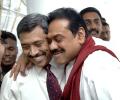
Gotabaya Rajapaksa

The ordinary life lived in Pakistan is rarely a part of Indian imagination. This is this gap that Pakistani television serials have succeeded in bridging, says Mohammad Asim Siddiqui.

In anticipation of a verdict to be delivered by the International Tribunal of the Permanent Court of Arbitration in The Hague on Tuesday, China has orchestrated a worldwide campaign to defuse its findings.
 © 2026 Rediff.com - Advertise with us - Disclaimer - Privacy Policy - Sitemap - Feedback - About us - Terms of use - Grievances